Friday, 17 April 2015

MicroType

Key Challenges

Majority of application are being built or under consideration to be built on service oriented architecture which encourages decoupling of components and services. This integration project usually grows in size considering its basic feature to allow/encourages change to absorb new functionality or enhancement to existing one.

In a project the issue is about the approach related to variable creation across the code base. What can we do to minimise variable scattering and group the similar candidate variables together so that its reusability can be enhanced in line as objects?  What different we can do to streamline and create sustainable uniformity so that readability, validation, type safety and code maintainability can be enhanced?


Problem Solver

Since Java is open source and new artifacts and patterns constantly gets added or improved. So to solve one problem it is highly possible that there exist 10 different ways and workaround. To solve above stated problem the team decided to choose MicroType among other available options.


When to create & use a MicroType

One of the negatives of MicroType is the overhead of creating them for values that ultimately pass straight through the system.  If a new service has 50 values coming in on the request, then there is a cost to developing 50 new MicroType.  It is highly likely that the some of the values already have had MicroType defined, in which case it’s probably worth creating those, but equally there are probably some new values that haven’t been defined as MicroType.  Creating one for each value will be excessive if they are not used.

I would use the following rule of thumb to decide when and when not to create a MicroType

·         If one already exists then there is no harm in creating a new one ( one object extra is not going to harm anyone)
·         If a java type is used in any method in the domain service – replacing the java type with our own protects us from changes to that type
·         If a java type is used in an if condition eg
o   e.g.  int fraudScore = 72; if (fraudScore > 90) – This warrants a FraudScore MicroType with a method isOverFraudLimit
·         If you have a list or map or some other data structure that needs a ‘home’
·         If a request variable is identified as a system pass through variable, then a MicroType isn’t required


MicroType benefits

It enables easy validation, attract common behaviour, provide type safety, make code more readable and easy to maintain. Microtypes are also immutable.

Example 1- Java is a typed language, and providing a MicroType gives us a single representation of a domain/middle layer integration concept. It solves the issue of primitives-obsession.


public abstract class MicroType {

    @Override
    public String toString() {
        return ToStringBuilder.reflectionToString(this);
    }

    @Override
    public boolean equals(final Object that) {
        return EqualsBuilder.reflectionEquals(this, that);
    }

    @Override
    public int hashCode() {
        return HashCodeBuilder.reflectionHashCode(this);
    }

}


public class ProductAccountNumber extends MicroType {

    private final String value;

    ProductAccountNumber(final String productAccountNumber) {
        this.value = productAccountNumber;
    }

    public String getValue() {
        return value;
    }
}


Summary

No one can mistake this for anything other than a ProductAccountNumber; if this was just a String then we are then reliant on the variable name informing us of its purpose.  But this variable name could be accountNumber, which can be interpreted as product account number, bank account number, credit card account number etc.  So providing a MicroType gives a single meaning throughout the code whereas relying on variable names does not.  If we have a badly named MicroType, then a simple rename in eclipse changes all references, throughout codebase, not so the case for variable names. 


Example 2
MicroType provide a place for common behaviour.

public class Day extends MicroType {

    private final DateTime dateTime;

    Day(final DateTime dateTime) {
        this.dateTime = dateTime.withTimeAtStartOfDay();
    }

    public boolean isWeekend() {
        final int dayOfWeek = dateTime.getDayOfWeek();
        return dayOfWeek == DateTimeConstants.SATURDAY || dayOfWeek == DateTimeConstants.SUNDAY;
    }

    public DateTime getDateWithoutTime() {
        final LocalDate localDate = new LocalDate(dateTime.getMillis());
        return localDate.toDateTimeAtStartOfDay();
    }

    public Day addDays(final int days) {
        return new Day(dateTime.plusDays(days));
    }

    public Day minusDays(final int days) {
        return new Day(dateTime.minusDays(days));
    }

    public boolean isAfter(final Day day) {
        return getDateWithoutTime().isAfter(day.getDateWithoutTime());
    }

    public boolean isSame(final Day compareDay) {
        return getDateWithoutTime().equals(compareDay.getDateWithoutTime());
    }

    public boolean isBefore(final Day day) {
        return getDateWithoutTime().isBefore(day.getDateWithoutTime());
    }

    public boolean isSameOrAfter(final Day compareDay) {
        return isSame(compareDay) || isAfter(compareDay);
    }

}


Summary

The Day MicroType which contains methods such as isWeekend(), isSame(Day day).  Any other Day type logic would naturally fit onto here, rather than being all over across the codebase. 
The second point is that method now become more descriptive as rather than passing in a java.util.date (which could includes time), we are now passing in a Day reference which perfectly describes what it does “isSame(Day)”. 
Day currently wraps org.jodatime.time.Datetime.  At some point in the future we may wish to move to Java 8’s new java.time.LocalDate.  We now only need to do this in one place, rather than exposing Joda DateTime throughout the codebase, we have minimised our dependencies.


Benefits in general

·        A MicroType is in essences simply a Wrapper class similar to Boolean, or Integer wraps a Boolean or an int, but they represent concepts in our business domain.  They don’t have to extend MicroType.  But doing so create a convenience for ToString, Equals and HashCode.  A MicroType is really an object that wraps a single java object or primitive.

·         Ideally a MicroType should be created at the edges of an application, i.e. in the endpoint or in the adapters / gateway.  This minimised impacts when a variable changes type in a wsdl or when a gateway /adapter is found to represent a type differently to what we expect.


·         Ideally a domain will only ever need to use domain model objects and MicroType for all method parameters, loops and if tests.

E.g.

getAccounts(ProductAccountNumber) is better than getAccounts(String) as the MicroType version communicates better what is needed to getAccounts.  Also some American services represent ProductAccountNumber as an int where as others represent it as a String.  Not using a MicroType means that we either need to do a int to String conversion or provide an overloaded method to getAccounts.

·         It will be much easier to implement the Null object pattern if required if we first have MicroType in place.

·         Common if tests can be pushed down into the MicroType ( e.g. Day.isSame(Day))

·         Lists, Maps or other collections benefit from becoming MicroType.    By wrapping a list and implementing Iterable, we can now use our MicroType in a For loop, without exposing the fact that it is a list, meaning that if we wanted to change this to a map, or a Set at some point in the future then we can easily.  It also provides a central place to ‘manage’ that list, so if a filter for the list was required and then it would naturally fit on this object. 

Few benefits on Unit Test

As MicroType contains toString(), HashCode(), Equals() there is no needs to write unit test in order to meet 100% tests pass mark. Again this is for test purposes in order that we can use Assert.assertThat(productAccountNumber, CoreMatchers.is(expectedProductAccountNumber)).  We can now create a expectedProductAccountNumber which is a different instance, but has the same value. But Feel free to implement your own equals, hashCode, and toString on the specific MicroType as and when the methods are used, or when you believe there is a problem. This is just a convenience for testing and not an enforced doctrine

MicroType disadvantage

It is obviously a subjective things as in some area it can provide great benefits, in other it can prove to be pointless.

Reference
http://www.tutorialspoint.com/design_pattern/null_object_pattern.htm


Thank You!
Satender Kumar Mall

Twitter: satenderiiit


Sunday, 15 March 2015

Forgotten Indian contribution to universe

When it comes to discuss about invention and discoveries made in this world. What is the first thing comes to our mind? Many will end up pondering that usually it was Britain or America. But you will be surprised when you will know that few inventions which was presented by west to world was already made by India. Now next question which might struck is why it was not conveyed to the world about the real inventor? Why India missed the bus which west managed to drive?


There may be series of factors but one common factor comes to my mind is “packaging”. Yes, India lacked packaging to markets it invention. Few months back in 2014 itself when our Science & Technology Minister Dr. Harsh Vardhan, asserted that “ancient Indian scientists discovered the Pythagoras' theorem but the credit is given to the Greeks.” To immense surprise very first resistance came to his statement was from silly Indian media, whose most of the desk editor believes in manufacturing news sitting in studio rather than from tangible ground work. Now I leave it to the audience to analyse & form opinion about the quality of experts whom you get to meet in new studio who shout their lungs out in debate and poor quality of homework they do before joining debate. Let’s back to the topic.

But the fact is Minister was correct. According to Ludwig von Schröder, (was a Prussian officer and Admiral during World War I)

Let’s have a look about few other core inventions:-

·         The number system or Hindu numeral system: 
     The number system has underpin the foundation of modern mathematics and its infinite uses in our day-to-day lives. This Indian system succeeded where the efforts of other great civilizations failed.


·         The clothes system we admire today

·         Democracy
During the modern era, racially motivated European 'historians' distorted or simply re-wrote significant Indian and colonial historical achievements, from pettily changing the date of the life and death of the revered Gautama Buddha, the founder of Buddhism, to make it appear as if he lived after Pericles and Socrates, to omitting known references to the existence of ancient Indian republics, known as Gana-Sangha (equal assembly), or Gana-Rajya (equal government).


·         Discovery of water on Moon


·         Religious tolerance

India has been the land which has provided platform for several religion to originate and thrive. To name few are Hinduism, Buddhism and Jainism etc. All religion has been master piece of peace propagation. They had been spread by Monks and Sadhu through poem etc.

Two things which has always puzzled me was decision of handing over Nobel peace prize to Barack Obama and His lecture to India on religious tolerance during his recent visit on Republic day. Now we can see again that India is a tolerant nation which still absorbed above incidents.

Historically, India has also been a long-standing refuge for persecuted minorities, with Zoroastrian Iranians (referred to as Parsis) and Jewish communities in particular having fled other parts of the world to make India a home when other major powers pursued systematic campaigns of discrimination and anti-Semitism, if not outright persecution, against them.


I Will stop my pen here and may be will write another to highlight many more...
Note: This post has been inspired by Abhaey Singh blogs and many Screen shot used are from Huffington Post.

Thank You!
Satender Kumar Mall
Twitter: satenderiiit


Tuesday, 3 February 2015

CEO's of famous Insurance Company worldwide !!

The following is the list of CEO's of famous Insurance Company worldwide until 1st Feb 2015.


Name
Company name
Company's Logo
 Shri S. K. Roy
Life Insurance Corporation of India
 
 Warren Buffett
 Berkshire Hathaway


 Yang Mingsheng
 China life Insurance
 
 Michael Diekmann
 Allianz

 Peter D. Hancock
American International Group (AIG)
 Ma Mingzhe             
 Ping An

 Steven A. Kandarian
 MetLife

 Henri de Castries
 AXA
 
 Mark Tucker
 AIA Group

 Ralph Hamers
 ING Group
 
 Martin Senn
 Zurich Insurance
 
 Stephen Hester
 RSA Insurance Group
 
 Ted Mathas
 New York Life Insurance


Thank You!
Satender Kumar Mall

Twitter: satenderiiit


Friday, 2 January 2015

Conversion & Re-Conversion

Freedom of religion in India is a fundamental right guaranteed by the country's constitution. Modern India came into existence in 1947 as a secular nation and the Indian constitution's preamble states that India is a secular state. Freedom of religion is established in tradition as Hinduism does not recognize labels of distinct religions and has no concept of blasphemy or heresy. Every citizen of India has a right to practice and promote their religion peacefully.

To be specific

Question that bound to strike you is if everything is clear then why Indian media going crazy about conversion and reconversion. “Media in India is trying to be courts and have shed the essence of journalism few decade ago” SURPRISE!!! Well to some extent you already know and if you happen to watch news quality and debate topic day in –day out, you will be able to figure out quite quickly. If you happen to be in social media especially twitter, it will be like cutting butter to come to a conclusion.

However coming to our topic, I will be discussing the real facts about this craziness in India. One of the facts that boil this issue is unending desire of Christianity and Islam for their inorganic growth.  Before going forward will urge reader to understand purely from angle of getting to the root of the issue instead of taking this as criticism of one religion or the other. India has been the land which has given birth to numerous religions as well as provided platform to thrive. Many think India is secular because Hindu is in majority. To some extent I do agree by simply piping to my neighbouring countries such as Pakistan, Bangladesh and China etc. Majority religion has increased whereas minorities has been considerably decreased or it will not be wrong if one say extinct.  

Being a convent educated and have travelled across India, I can conclude that conversion is not a problem in itself but means with which is done is real problem. Numerous evangelist and Christian organisation lured tribal’ s  to convert by promising them jobs, medical/financial help (When in needs). It has worked in their goal to large extent but again Jesus can provide hope and evangelist also has limit of their resources to fulfil the promise made while conversion. When people converted purely to avail promised services and did not find one, take rescue back to their original fold hence reconversation. Now you must be thinking it all looks simple & fair to some extent then where is the problem?

The problem starts when media acts like housefly (transporter of dirt) and It starts planting stories only when reconversion happens and gives total miss to initial conversion and its malpractice. Politically and even from the media's side, there is a selectiveness over conversion cases. This to some extent incites communal tension in society and reaction you must have well experienced. MediaCrooks has rightly put it “Tolerance is a one-way street in India. The Hindus are expected to tolerate the nonsense from the speakers and acts of members of certain imported religions.” (Also read Conversions -At Their Wits End by MediaCrooks)

Role of Indian Government
Indian government is bound by constitution of India which clearly gives freedom of religion. It cannot do much in absence of law. Victim of conversion/re-conversion does not know under which law to files a complaint (Article 25). Current government has asked all parties to provide consent to create a law but this is would shut shop of many so called pseudo-secular parties which thrive on this issue. For now this is distant dream. Unless it is a serious criminal case, conversion cases should be left alone. Just like people shift political parties for money, grants and position, they will do the same for religion.

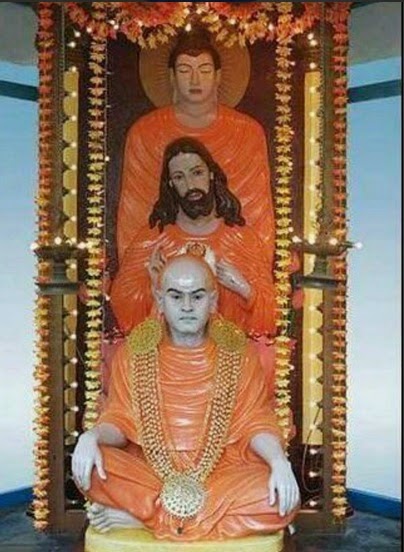
Look carefully the malicious means used by many Christian missionary to expand Christianity through inorganic model. Some of them can be termed as mare fraud. You must have got good idea after reading mediaCrooks article with proof. As we know too much of inorganic expansion kills the basic instinct purpose. They have replicated Jesus to alike of Hindu Gods to cheat people. I sometime wonder what western world (who to some extent are born Christian) reaction would be by seeing Jesus re-conversion? 


Jesus as Buddha

Jesus as Brahama

Total deception

Jesus as Krishna-Arjuna

White dress changed to Hindu Saffron clan

Shiv ling in Church
Jesus like Lord Vishnu


Apart from the above conversion and re-conversion's biased, trick, cheat, force etc. cartoon has its own flavor to express its way about what common people think about it. Have a look...


Thank You!
Satender Kumar Mall
Twitter: satenderiiit